
We are also working to incorporate urgent measures from other international human rights bodies in the near future, including the African human rights system and United Nations treaty bodies.
1. Welcome
Welcome to this resource on urgent measures in international human rights law.
This page is designed to help you navigate our database of urgent measures and understand the work of the research groups behind it — the Programme for Studies on Human Rights in Context and the IMPACTUM project.
Whether you are a researcher, a legal practitioner, a student, or simply someone interested in how international human rights bodies protect people at risk, this guide will walk you through what you can find here and how to make the most of it.
Use the index on the left to explore each section at your own pace.
2. Urgent Measures: An Overview
3. About This Database
This database currently includes all provisional and precautionary measures issued within the Inter-American human rights system — provisional measures granted by the Inter-American Court of Human Rights (IACtHR) since 1990, and precautionary measures granted by the Inter-American Commission on Human Rights (IACHR) since 1994. This represents all the information publicly available online from each body. To date, more than 2,500 measures have been published and coded, and this number will continue to grow as both bodies issue further measures.
We are also working to incorporate urgent measures from other international human rights bodies in the near future, including the African human rights system and United Nations treaty bodies.
Measures are published in Spanish and, where available, in English, Portuguese, or French. You can filter the database by country, year, status of the measure, type of measure, and keyword — including the name of the measure, the right protected, or the protected group. The following section explains how to use these filters in more detail.
4. How to Search
From the homepage, click "View all measures" to access the full database.
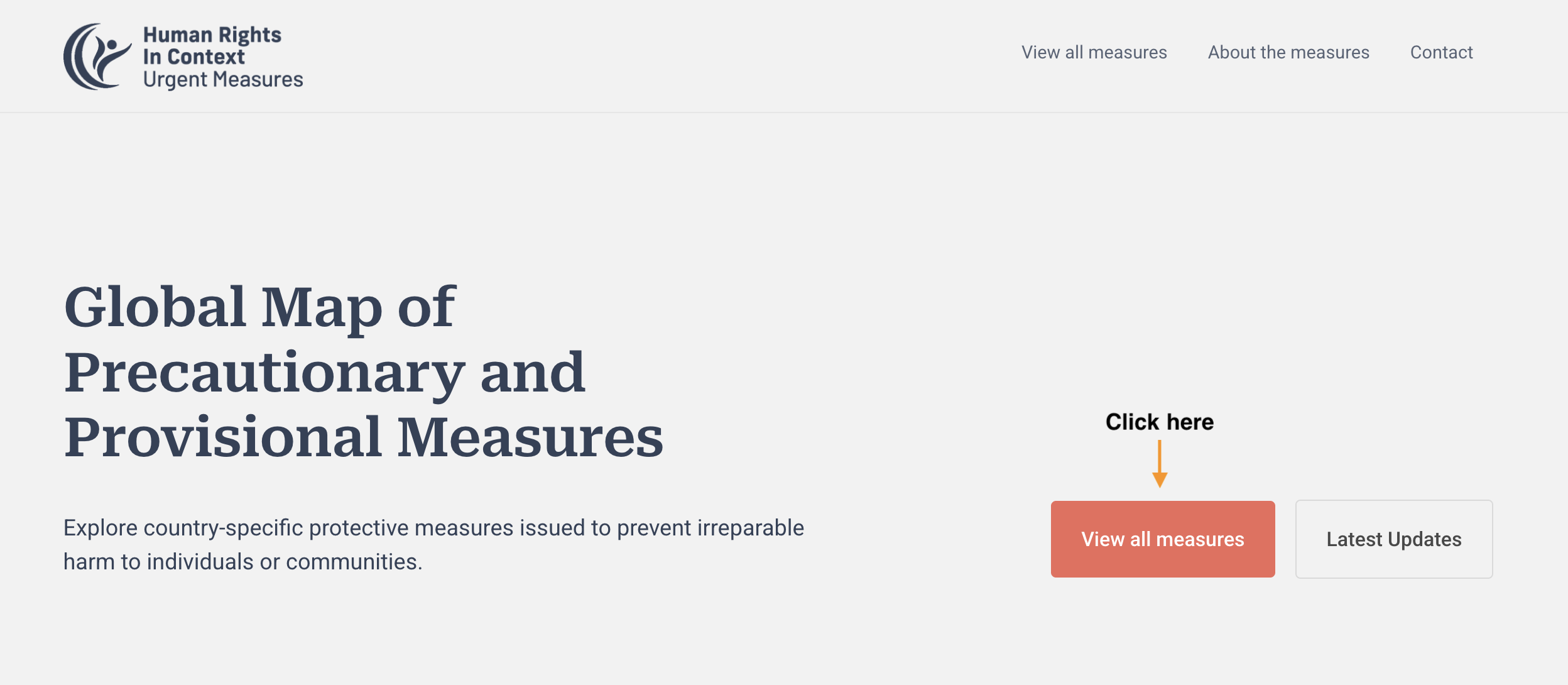
Please note the database may take a few seconds to load on your first visit, given the large number of measures it contains.
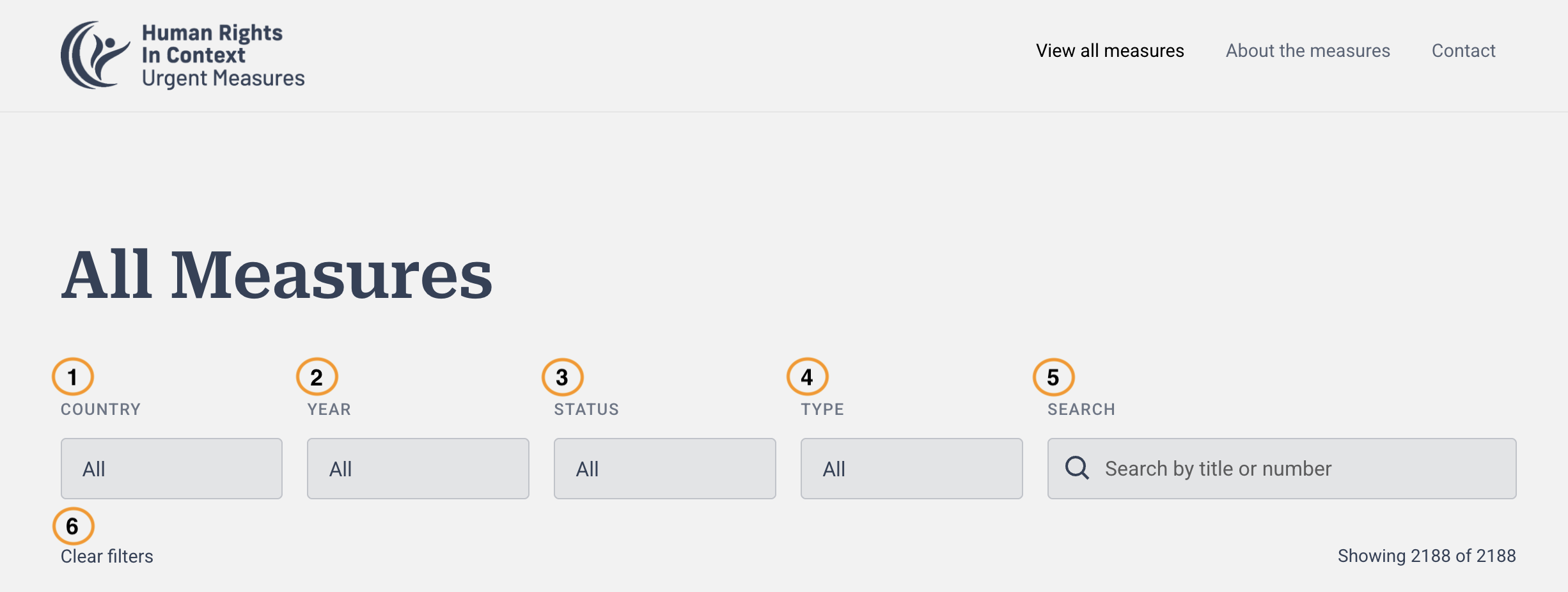
The "All Measures" page allows you to filter and search the database in several ways. You can combine as many filters as you like to narrow down your results.
1. Country
Filter measures by the country they concern.
2. Year
Filter measures by the year in which they were issued.
3. Status
Filter measures by their current status — for example, whether they have been granted, lifted, extended, rejected, or withdrawn, among other options.
4. Type
Filter by type of measure: provisional measures (IACtHR) or precautionary measures (IACHR).
5. Search
Use the search bar to look up measures by title or case number. You can also search by the protected group — such as human rights defenders, persons deprived of liberty, migrants, journalists, or witnesses — or by the protected right, such as the right to life, personal integrity, health, or freedom of expression.
All filters can be used together — for example, you could filter for all measures issued in Guatemala, in 2020, that are currently in force, and further narrow the results using the search bar for measures related to a specific protected group or right.
6. Clear Filters
If you would like to start a new search, simply click "Clear Filters" to reset all fields at once.
5. Human Rights in Context
The Programme for Studies on Human Rights in Context is an interdisciplinary research platform dedicated to advancing research and practice in the fields of human rights, democracy, and the rule of law. It brings together professors, practitioners, and researchers from within and beyond Ghent University (Belgium), fostering collaboration across academic disciplines and professional fields.
Founded in 2018 and led by Prof. Dr Yves Haeck and Prof. Dr Clara Burbano-Herrera, the programme combines academic rigour with practical engagement, ensuring that its work remains closely connected to real-world challenges. The programme is embedded within the Faculty of Law and Criminology at Ghent University.
Focus Areas
Our research examines how international human rights bodies function, how national institutions operate, and how the two levels interact — with a particular focus on states marked by social exclusion, high levels of violence, and weak institutions. Grounded in theory and extensive fieldwork, our work combines a comprehensive approach to public law with a strong comparative perspective, in line with Ghent University's spirit to 'Dare to Think'.
6. IMPACTUM
A research project within the Programme for Studies on Human Rights in Context
IMPACTUM (Assessing the IMPACT of Urgent Measures in Protecting At-Risk Detainees in Latin America) is a large-scale research project funded by the European Research Council (ERC) and hosted at Ghent University, Belgium. Led by Principal Investigator Prof. Dr. Clara Burbano-Herrera, it examines the impact of urgent measures adopted by international human rights bodies to protect persons deprived of their liberty across six Latin American countries: Colombia, Peru, Ecuador, Guatemala, El Salvador, and Nicaragua.
Combining desk research with qualitative empirical methods, IMPACTUM examines how urgent measures are applied on the ground, their impact on detainees and on legal, institutional, and international actors, and their strengths, limitations, and broader learning effects. The project aims to develop a critical normative impact framework, offering both theoretical insight and practical guidance on how urgent measures can be formulated to maximise their protective effect.
IMPACTUM is carried out by an interdisciplinary team working across law, criminology, and political science, based at the Programme for Studies on Human Rights in Context (Ghent University). The team is supported by an Interdisciplinary International Advisory Board (IIAB) comprising scholars, judges, and human rights practitioners, alongside an Ethics Advisor.
Engaging with Human Rights Bodies
Human Rights in Context and IMPACTUM engage in an active dialogue with international human rights bodies by submitting amicus curiae briefs and presenting expert opinions during public hearings before bodies such as the UN Human Rights Council, the UN Special Rapporteur on Torture, the Inter-American Court of Human Rights, and the Subcommittee on Prevention of Torture.
In addition, Prof. Burbano-Herrera and Prof. Haeck were part of the group of scholars involved in drafting the Nijmegen Principles and Guidelines on Interim Measures for the Protection of Human Rights.